动手学深度学习 3.9 多层感知机的从零开始实现

前言

从零开始学习ai文章系列计划是个人在《动手学深度学习》和《磨菇书》两本书的学习中的个人笔记,文章也会以课本中的章节分开,即每个章节一片笔记。我会尽量的把主要内容以及遇到的难点进行记录与解决,如果哪里有错误的欢迎指正。或者不清晰的可以直接查看原文部分。

《动手学深度学习》原文(课本):https://tangshusen.me/Dive-into-DL-PyTorch/#/

《动手学深度学习》代码:https://github.com/ShusenTang/Dive-into-DL-PyTorch

(由于有时候公式太多,可能会直接贴图片)

这节我们用多层感知机来解决之前的图片分类问题。

本节基础代码较多,也有许多以前用过的函数,不会进行过多解释占用额外篇幅。

1. 获取和读取数据

继续用之前的图片数据fashion_mnist。

1
2
3
4
5
6
7
8
9
10
11
12
13
14
15
16
17
18
19
20
21
22
def load_data_fashion_mnist(batch_size, resize=None, root='~/Datasets/FashionMNIST'):
"""Download the fashion mnist dataset and then load into memory."""
trans = []
if resize:
trans.append(torchvision.transforms.Resize(size=resize))
trans.append(torchvision.transforms.ToTensor())

transform = torchvision.transforms.Compose(trans)
mnist_train = torchvision.datasets.FashionMNIST(root=root, train=True, download=True, transform=transform)
mnist_test = torchvision.datasets.FashionMNIST(root=root, train=False, download=True, transform=transform)
if sys.platform.startswith('win'):
num_workers = 0 # 0表示不用额外的进程来加速读取数据
else:
num_workers = 4
train_iter = torch.utils.data.DataLoader(mnist_train, batch_size=batch_size, shuffle=True, num_workers=num_workers)
test_iter = torch.utils.data.DataLoader(mnist_test, batch_size=batch_size, shuffle=False, num_workers=num_workers)

return train_iter, test_iter


batch_size = 256
train_iter, test_iter = d2l.load_data_fashion_mnist(batch_size)

2. 定义模型参数

1
2
3
4
5
6
7
8
9
10
11
num_inputs, num_outputs, num_hiddens = 784, 10, 256

W1 = torch.tensor(np.random.normal(0, 0.01, (num_inputs, num_hiddens)), dtype=torch.float)
b1 = torch.zeros(num_hiddens, dtype=torch.float)
W2 = torch.tensor(np.random.normal(0, 0.01, (num_hiddens, num_outputs)), dtype=torch.float)
b2 = torch.zeros(num_outputs, dtype=torch.float)

params = [W1, b1, W2, b2]
for param in params:
param.requires_grad_(requires_grad=True)

3. 定义激活函数

1
2
def relu(X):
return torch.max(input=X, other=torch.tensor(0.0))

torch.max函数接受2个参数,第一个数输入的矩阵X,第二个other参数是标量0。其作用是X中每个数与0进行比较,区最大的值作为新矩阵中的元素。其结果是与X同大小的,大于等于0的新矩阵。

4. 定义模型

1
2
3
4
def net(X):
X = X.view((-1, num_inputs))
H = relu(torch.matmul(X, W1) + b1)
return torch.matmul(H, W2) + b2

5. 定义损失函数

为了得到更好的数值稳定性,我们直接使用PyTorch提供的包括softmax运算和交叉熵损失计算的函数。

1
loss = torch.nn.CrossEntropyLoss()

6. 训练模型

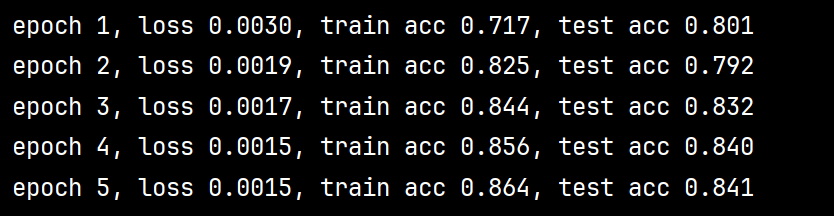
训练多层感知机的步骤和3.6节中训练softmax回归的步骤没什么区别。我们直接调用d2lzh_pytorch包中的train_ch3函数,它的实现已经在3.6节里介绍过。我们在这里设超参数迭代周期数为5,学习率为100.0。

(学习率之所以这么大,应该是因为d2lzh_pytorch里面的sgd函数在更新的时候除以了batch_size,其实PyTorch在计算loss的时候已经除过一次了,sgd这里应该不用除了)

1
2
3
4
5
6
7
8
9
10
11
12
13
14
15
16
17
18
19
20
21
22
23
24
25
26
27
28
29
30
31
32
def train_ch3(net, train_iter, test_iter, loss, num_epochs, batch_size,
params=None, lr=None, optimizer=None):
for epoch in range(num_epochs):
train_l_sum, train_acc_sum, n = 0.0, 0.0, 0
for X, y in train_iter:
y_hat = net(X)
l = loss(y_hat, y).sum()

# 梯度清零
if optimizer is not None:
optimizer.zero_grad()
elif params is not None and params[0].grad is not None:
for param in params:
param.grad.data.zero_()

l.backward()
if optimizer is None:
sgd(params, lr, batch_size)
else:
optimizer.step()

train_l_sum += l.item()
train_acc_sum += (y_hat.argmax(dim=1) == y).sum().item()
n += y.shape[0]
test_acc = evaluate_accuracy(test_iter, net)
print('epoch %d, loss %.4f, train acc %.3f, test acc %.3f'
% (epoch + 1, train_l_sum / n, train_acc_sum / n, test_acc))

num_epochs, lr = 5, 100.0
d2l.train_ch3(net, train_iter, test_iter, loss, num_epochs, batch_size, params, lr)


当多层感知机的层数较多时,本节的实现方法会显得较烦琐,例如在定义模型参数的时候。